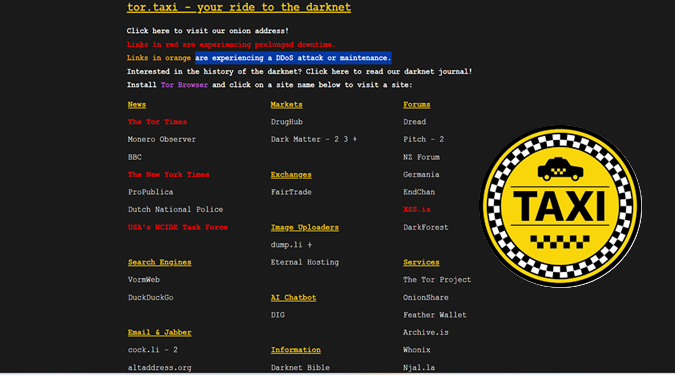
The Tor ecosystem continues to grow as privacy-conscious users seek alternatives to traditional internet browsing. Among the many resources available within the Tor network, Tor Taxi has emerged as one of the most widely discussed directories for discovering and verifying onion services.
Because onion addresses frequently change, become unavailable, or are targeted by impersonation sites, many users rely on trusted directories to locate active resources. Tor Taxi serves as one such gateway, helping users discover verified destinations across the Tor network while reducing the risk of visiting fraudulent links.
Understanding Tor Taxi Links
Tor Taxi (tor.taxi) functions as a curated index and verification hub for darknet onion sites. It provides verified .onion addresses for popular services including forums, markets, and privacy resources. Its clearnet mirror and onion presence make it accessible while emphasizing safety through status monitoring — highlighting uptime, known issues, and potential phishing risks.
Unlike random link aggregators, Tor Taxi focuses heavily on anti-phishing measures, offering PGP signatures for verification and encouraging cross-checking. This makes it a dependable “taxi” for navigating the Tor ecosystem safely.
What Tor Taxi Typically Provides
- Access to categorized onion resources
- Updated tor network links
- Verification information for popular services
- Navigation assistance for new Tor users
- Alternative mirrors when services become unavailable
For the latest trending darknet sites and updated directories, see this trending darknet sites guide.
How Tor Works: A Brief Overview
Tor, short for The Onion Router, is a decentralized network that anonymizes internet traffic by routing it through multiple volunteer-operated relays. Your data is wrapped in multiple layers of encryption — similar to the layers of an onion — and passed through an entry node, middle relay, and exit node. Each relay only knows the previous and next hop in the circuit.
This design effectively hides your real IP address and physical location. Tor also supports hidden services (.onion sites), where both the client and server remain anonymous to each other. Academic research on onion routing has consistently demonstrated its strength against many forms of surveillance, although it comes with slower connection speeds compared to the regular internet.
Benefits of Using Tor for Privacy and Anonymity
- Strong IP Masking: Prevents ISPs, governments, and websites from easily tracking your origin.
- Censorship Resistance: Essential for journalists, activists, and users in oppressive regimes.
- Access to Hidden Services: Secure access to forums, libraries, and communication tools unavailable on the clearnet.
- Open Source Transparency: The code is publicly auditable by security researchers worldwide.
- Free to Use: No cost barrier for anyone seeking digital privacy.
Those interested in Tor-focused discovery tools can also read: Unlocking Dark Web Search Engines .
Risks Associated with Using Tor Taxi Links
Even with trusted directories like Tor Taxi, users must remain vigilant:
- Phishing sites that mimic legitimate directories.
- Malware hosted on certain .onion domains.
- Potential traffic analysis by advanced adversaries.
- Exit node vulnerabilities (mitigated when using .onion services).
- Legal scrutiny if accessing illegal content.
Important: Always verify links using PGP signatures and cross-reference multiple trusted sources.
Best Practices for Safely Navigating the Tor Network
- Download the Tor Browser exclusively from the official Tor Project website.
- Keep your Tor Browser and operating system fully updated.
- Avoid downloading files from unknown sources.
- Set security level to “Safest” (disables JavaScript by default).
- Use verified links from Tor Taxi and avoid clicking suspicious ads or links.
- Never share personal information or use the same identities across clearnet and dark web.
- Consider running Tor in Tails OS for maximum compartmentalization.
Security depends not only on technology but also on user behavior and awareness.
Tools and Resources for Enhanced Security on Tor
Password Managers
Password managers help generate and securely store unique credentials.
Multi-Factor Authentication
Multi-factor authentication provides additional protection whenever supported.
PGP Encryption
PGP remains a useful tool for identity verification and secure communication.
Trusted Directories
Reputable directories can help users locate services more efficiently than relying on random internet searches.
Common Misconceptions About Tor and Its Uses
Tor Is Illegal
In many countries, using Tor is completely legal and widely accepted for privacy-focused purposes.
Only Criminals Use Tor
Journalists, researchers, activists, and ordinary citizens use Tor every day.
Tor Guarantees Complete Anonymity
Tor significantly improves privacy but cannot eliminate every possible risk.
All Onion Sites Are Dangerous
Many onion services provide legitimate resources related to privacy, free expression, and information sharing.
Tor Taxi Link vs Torch Search Engine Link
Tor Taxi and Torch are frequently compared because both help users discover resources within the Tor network.
| Feature | Tor Taxi | Torch Search Engine |
|---|---|---|
| Primary Function | Directory | Search Engine |
| Link Discovery | Curated Listings | Indexed Results |
| Verification Focus | Higher | Lower |
| User Experience | Structured Navigation | Broad Exploration |
| Risk of Unknown Results | Lower | Higher |
Beginners often prefer Tor Taxi because of its organized approach, while Torch may appeal to users conducting broader research.
As interest in exploring the dark web continues to grow among everyday users, researchers, and journalists, Torzle.app has compiled a list of prominent .onion services to help readers become familiar with the darknet before diving in. Explore more by visiting torzle blog and torzle guides.
Legal Implications of Using the Tor Network
Using the Tor network itself is legal in most countries, including the United States and European Union, for privacy protection, research, and accessing information. However, committing illegal acts through Tor (such as purchasing contraband or engaging in cybercrime) remains illegal and can lead to prosecution. Law enforcement agencies actively monitor parts of the network but generally target behavior rather than mere usage of the tool.
Researchers, journalists, and privacy advocates regularly reference Tor in academic literature on digital rights and cybersecurity.
Conclusion: Embracing Privacy with Caution
Tor Taxi continues to serve as a valuable secure gateway in the complex ecosystem of tor network links. By combining verified directories, sound operational security practices, and a clear understanding of risks, users can responsibly explore the privacy benefits that Tor offers.
As digital surveillance technologies evolve, tools like Tor and trusted indexes such as Tor Taxi remain critical for preserving online freedom. Approach the dark web with informed caution, continuous verification, and strict adherence to legal and ethical boundaries. Responsible use of these technologies helps ensure the future of digital privacy for everyone.
References & Further Reading
This article is for educational and informational purposes only. Academic references include studies on onion routing from arXiv, Tor Project research papers, Springer publications on anonymity networks, and analyses of dark web directories. Always verify links independently and comply with all applicable laws.