Darknet Drug Market Takedowns: Law Enforcement Tactics
Law Enforcement Tactics Against Darknet Drug Dealers
The digital underworld has long been characterized by a perpetual game of cat and mouse. On one side are cybercriminals hiding behind the cryptographic veils of the Tor network; on the other, a highly sophisticated network of global police forces dedicated to dismantling their operations. Over the past decade, the strategies utilized by authorities have evolved from basic cyber investigations to highly coordinated, multi-national strikes.
For anyone looking to understand the modern state of digital justice, examining the Law enforcement tactics against darknet drug dealers, including the Archetyp darknet drug market takedown and broader global cybercrime operations, provides a masterclass in modern investigative methodology. Authorities are no longer simply playing whack-a-mole; they are systematically dismantling the infrastructure, finances, and logistics of the digital underworld.
In this comprehensive guide, we will pull back the curtain on how global agencies infiltrate hidden networks, follow the digital money trail, intercept physical packages, and ultimately bring shadowy vendors to justice.

The Evolution of the Digital Underworld
To understand current law enforcement tactics, we must first understand the environment they are policing. A dark web marketplace operates similarly to traditional e-commerce platforms like Amazon or eBay, but with a few critical differences: they are accessible only via specialized routing browsers (like Tor), all transactions are conducted in cryptocurrency, and the products sold are predominantly illegal.
Since the infamous takedown of Silk Road in 2013, the illegal drug trade has increasingly migrated online. Vendors and buyers alike are drawn to the perceived anonymity of the internet. A modern darknet drug market features user reviews, vendor ratings, escrow services, and dispute resolution tickets—mimicking legitimate commerce to build trust among criminals.
However, as these marketplaces evolved, so did the authorities. The days of acting with total impunity on the dark web are over. Today, law enforcement utilizes a hybrid approach, blending cutting-edge digital forensics with traditional, boots-on-the-ground detective work.
Behind the Scenes: The Archetyp Market Takedown
One of the most revealing examples of modern policing in action is the recent operation against Archetyp. At its peak, Archetyp was one of the largest and most resilient darknet markets, specifically known for its strict focus on narcotics and its sleek, user-friendly interface.
The Archetyp market seizure investigation details highlight a patient, multi-layered approach by law enforcement. Authorities didn’t just want to shut the site down; they wanted the administrators, the top vendors, and the underlying server infrastructure.
How Authorities Uncover the Servers
A critical question in any cyber investigation is how authorities seize onion site servers when their physical locations are cloaked by the Tor network. In the Archetyp case—and similar large-scale takedowns—investigators utilized a combination of traffic analysis, server misconfigurations, and international subpoenas.
When a darknet market grows too large, the infrastructure required to host it becomes complex. Administrators often have to lease massive server space from bulletproof hosting providers. Investigators probe these sites relentlessly for "IP leaks." A simple coding error in the site's backend, an improperly configured SSL certificate, or a flawed connection to an external database can briefly expose the true IP address of the server.
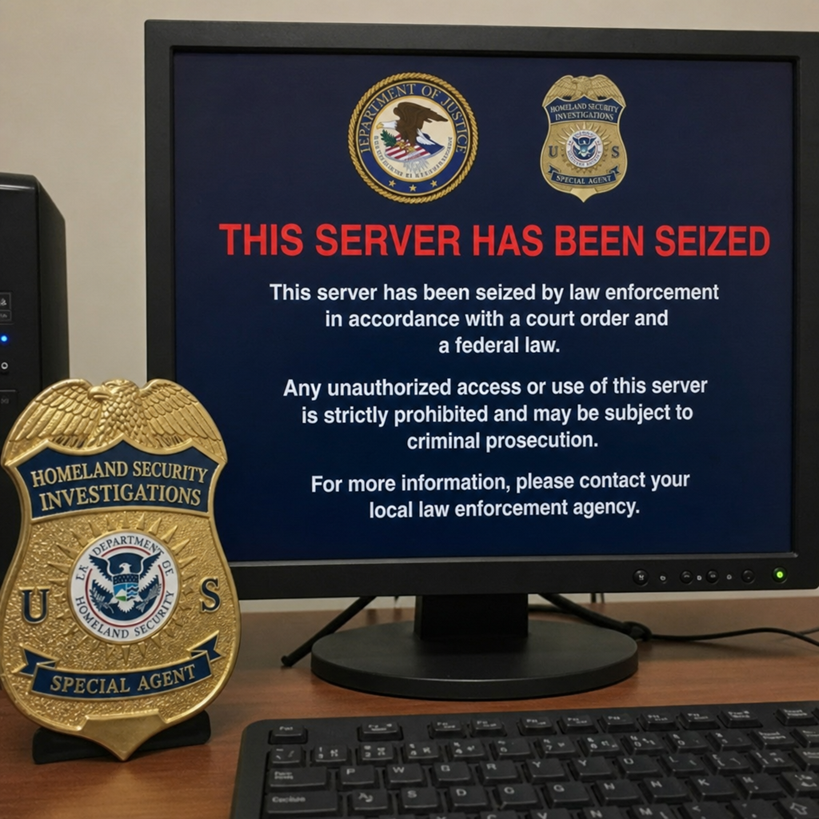
Once the IP is discovered, authorities use Mutual Legal Assistance Treaties (MLATs) to compel the hosting country to hand over the physical servers. By seizing the servers of Archetyp, law enforcement gained access to a treasure trove of data: unencrypted backend communications, vendor ledgers, and buyer addresses.
Following the Digital Breadcrumbs
The anonymity of the dark web relies heavily on two pillars: cryptocurrency and encryption. Law enforcement has developed specialized techniques to crack both.
Cracking the Crypto Trail
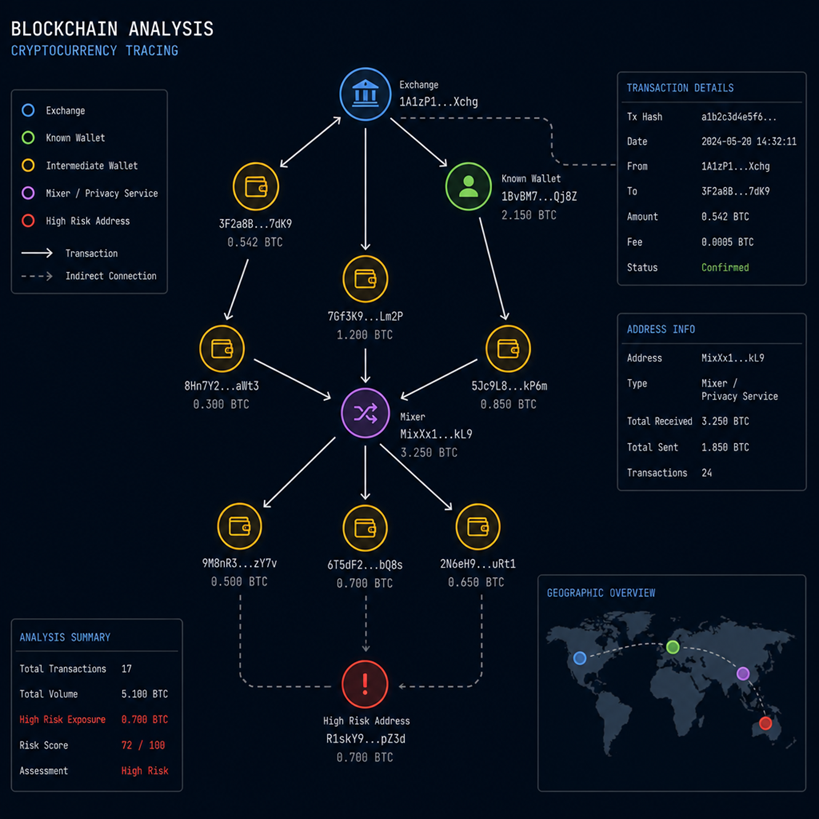
Criminals mistakenly believe that cryptocurrencies like Bitcoin are entirely anonymous. In reality, Bitcoin operates on a public ledger. Every transaction is recorded permanently. Blockchain analysis for cryptocurrency tracing has become one of the most devastating weapons in the law enforcement arsenal.
Agencies employ advanced heuristic software developed by companies like Chainalysis and Elliptic. These tools cluster cryptocurrency addresses, identifying patterns that link a seemingly anonymous darknet market wallet to a known entity.
Here is how the tracing process generally works:
- Initial Purchase: A buyer purchases Bitcoin on a regulated exchange (which requires Know Your Customer/KYC identification).
- Transfer to Market: The buyer transfers the funds to a darknet market wallet.
- Vendor Payout: The vendor sells their product and moves the funds to an external wallet.
- The Cash Out: Eventually, the vendor must convert that cryptocurrency into fiat money (dollars, euros, etc.) to buy physical goods. They often use centralized exchanges to do this.
Blockchain analysts trace the "hops" between these wallets. Even if a vendor uses "mixers" (services that jumble coins together to obscure the trail), modern algorithms can often untangle the web, identifying the exact moment illicit funds touch a regulated exchange. Once that happens, a subpoena is issued, and the vendor's real-world identity is revealed.
Digital Forensics and Deanonymization
Beyond the money, police must identify the computer infrastructure. Digital forensics for server deanonymization involves analyzing the digital footprint left by the market administrators. This includes analyzing server logs for administrative logins. If an admin logs into the server from their home IP address without properly routing their connection through Tor or a VPN, their location is compromised.
Furthermore, forensic experts perform RAM (Random Access Memory) dumps during physical raids. If a server or an admin's laptop is seized while it is turned on and logged in, investigators can capture the decryption keys stored temporarily in the RAM, bypassing hard drive encryption entirely.
The Cryptography Challenge
The role of PGP encryption in criminal investigations cannot be overstated. PGP (Pretty Good Privacy) is used by buyers and vendors to encrypt their messages, particularly physical mailing addresses. When implemented correctly, PGP is virtually unbreakable.
However, law enforcement often bypasses the need to crack the encryption through human error. Vendors sometimes forget to encrypt a message, copy/paste errors occur, or they save the plaintext version of addresses on their local hard drives. If a vendor is arrested and their computer is seized while unlocked, all those supposedly secure PGP messages become instantly readable to investigators.
Boots on the Ground: Physical and Undercover Tactics
While cyber forensics can locate the digital infrastructure, bringing down drug dealers requires physical interceptions and human intelligence. The transition from the digital realm to the physical world is where most criminals are caught.
Infiltrating the Shadows
Undercover infiltration of illicit marketplaces is a standard and highly effective tactic. Law enforcement agents create aliases and operate on these platforms as buyers, vendors, or even site moderators.
By acting as a buyer, an undercover agent can make controlled purchases. This allows them to gather physical evidence (the drugs, the packaging, the postmark) and trace the digital payment. In more complex operations, agents have posed as money launderers or specialized suppliers, slowly climbing the ranks of a criminal syndicate until they gain the trust of the market administrators.
The Mail Trap
A major logistical hurdle for online drug dealers is the physical delivery of the product. They must rely on traditional postal services. This leads to the question of how police track darknet drug shipments.
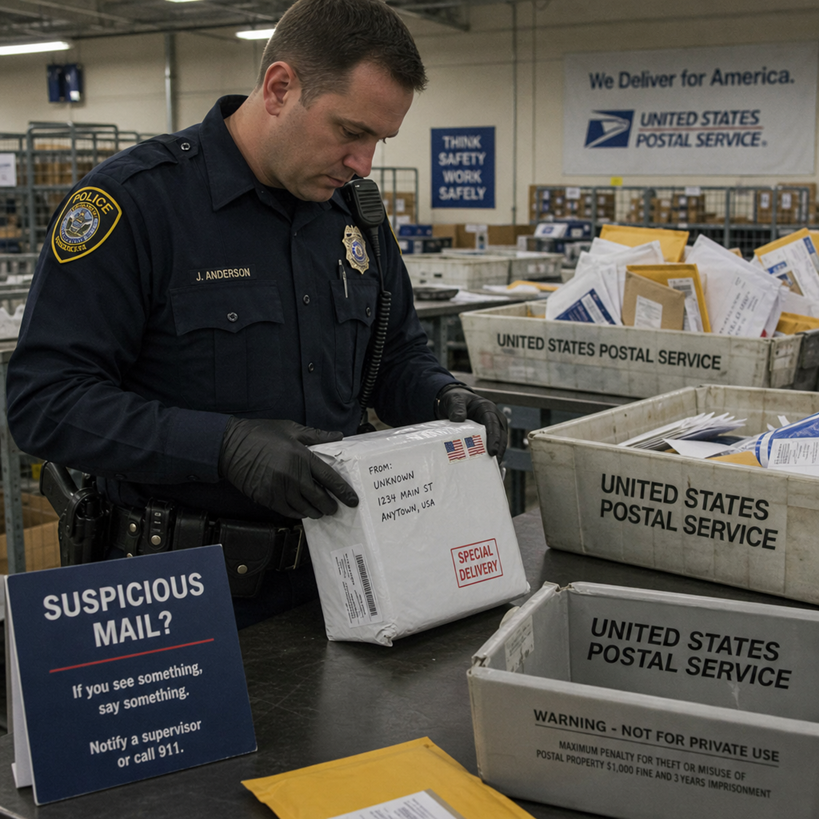
Postal inspection services and customs agencies use sophisticated profiling matrices to identify suspicious packages. They look for:
- Anomalous Weights: Packages that weigh slightly more or less than their declared contents.
- Handwriting and Labels: Specific printing techniques or repetitive, fake return addresses.
- X-Ray Signatures: Scanners that can identify the density of organic materials (like pills or powders) hidden inside innocuous items like DVD cases or toys.
- Scent: Advanced canine units trained to detect synthetic opioids, cocaine, and cannabis, even when heavily vacuum-sealed.
Securing the Arrest
Once a suspicious package is identified and intercepted, authorities utilize controlled delivery techniques for illegal substances. Instead of simply confiscating the package, they use it to trap the buyer or the vendor.
The process usually follows these steps:
- Interception and Testing: The package is opened, the illicit contents are confirmed, and a portion of the drugs may be replaced with a harmless look-alike substance.
- Tracking Device: A tiny GPS tracker or a "break-wire" sensor (which alerts police the moment the package is opened) is hidden inside.
- The Delivery: An undercover officer, dressed as a regular postal worker, delivers the package to the target address.
- The Raid: Once the target brings the package inside and opens it, the sensor triggers. Law enforcement, armed with an anticipatory search warrant, immediately raids the premises. This ensures the suspect is caught red-handed with the open package, destroying any defense of "I didn't know what was in the mail."
Global Task Forces: United Against Cybercrime
The internet has no borders, and darknet marketplaces operate on a truly global scale. A server might be in Iceland, the administrator in Russia, the vendor in the Netherlands, and the buyer in the United States. To combat this, law enforcement has had to tear down jurisdictional walls.
Collaborative Policing
When examining the Europol vs FBI cybercrime task forces, it is less about a rivalry and more about synergistic collaboration.
The FBI (often working alongside Homeland Security Investigations and the DEA) brings immense technological resources, funding, and domestic prosecutorial power to the table.
Europol, on the other hand, acts as a massive intelligence hub. Europol does not have the power to arrest citizens; instead, it coordinates information sharing and joint operations across diverse European legal jurisdictions, ensuring that a raid in Germany happens at the exact same second as a raid in France.
Targeting Specific Threats
Because of the devastating opioid crisis in North America, specialized units have been formed. The Joint Criminal Opioid and Darknet Enforcement task force (JCODE) is an FBI-led initiative specifically designed to disrupt the sale of synthetic opioids, like fentanyl, on the dark web. JCODE brings together postal inspectors, drug enforcement agents, and cyber experts to focus entirely on dismantling opioid supply chains from the point of manufacture to the final mail delivery.
This level of international cooperation in cross-border cybercrime is unprecedented. The success of modern takedowns relies on MLATs, shared intelligence databases, and joint command centers where officers from a dozen different countries sit side-by-side to orchestrate synchronized global raids.
Major Operations and Real-World Impact
The culmination of these sophisticated tactics is evident in sweeping, multi-national stings. A prime example is the recent Operation SpecTor.
Operation SpecTor
The Operation SpecTor global enforcement results sent shockwaves through the digital underworld. Coordinated across three continents, this massive sting operation resulted in:
- 288 Arrests: Targeting prominent vendors and buyers across the US, Europe, and South America.
- $53.4 Million Seized: Recovered in a mix of fiat currency and cryptocurrency.
- Physical Seizures: Over 850 kilograms of illicit drugs (including fentanyl and methamphetamine) and 117 illegal firearms were taken off the streets.
Operation SpecTor was born from the intelligence gathered during previous market takedowns. Law enforcement used data scraped from seized servers to identify the most prolific vendors, mapping their connections and systematically hunting them down.
Does it Stop the Trade?
One must ask about the true impact of market takedowns on drug supply chains. Do these operations actually stop the flow of drugs?
While a single market takedown will not permanently eradicate the darknet drug trade, it has profound, cascading effects:
- Erosion of Trust: When users see major markets fall, paranoia sets in. Buyers don't know if the vendor they are messaging is actually a cop.
- Financial Disruption: Millions of dollars locked in market escrow accounts are seized, financially ruining major syndicates.
- Deterrence: Highly publicized arrests of buyers deter the "casual" dark web user, shrinking the customer base.
- Supply Chain Bottlenecks: Removing top-tier bulk vendors creates immediate, localized droughts of specific narcotics, driving up prices and disrupting downstream street-level distribution.
Why Vendors Get Caught: OpSec Failures and Traps
Despite the cryptographic safety nets provided by Tor and PGP, humans are inherently flawed. Law enforcement relies heavily on the hubris, laziness, and mistakes of cybercriminals.
The Human Element
Analyzing the common OpSec (Operational Security) mistakes of darknet vendors reveals how easily digital criminals can trip up.
- Password/Username Reuse: A vendor might use the handle "DarkLord99" on a darknet market, but also use the same handle on a public gaming forum linked to their real email address.
- The "Clear Web" Crossover: Vendors often ask for technical help on sites like StackOverflow regarding coding or server management, inadvertently leaving breadcrumbs pointing back to their illicit sites (a mistake that helped catch the creator of the Silk Road).
- Linguistic Profiling: Investigators use stylometry (the linguistic analysis of writing styles) to match a vendor's dark web product descriptions to public social media posts. The use of specific slang, emojis, or grammatical errors can act as a digital fingerprint.
- Bragging: The desire for recognition often overrides caution. Vendors have been caught posting pictures of their wealth, vehicles, or even their physical surroundings, which investigators geolocate.
The Ultimate Trap: Honeypots
Perhaps the most psychologically devastating tactic used by authorities is the deployment of honeypot operations in hidden services.
Rather than immediately shutting down a darknet market once they breach its servers, law enforcement agencies sometimes secretly take control of it. They lock out the original administrators but keep the market running normally for weeks or even months.
During this time, the police operate the market. They quietly disable security features, capture plaintext passwords, log the unencrypted IP addresses of buyers and vendors, and monitor every single transaction.
This tactic—famously deployed by Dutch police during the takeover of the Hansa market in 2017—creates ultimate paranoia within the community. When authorities finally pull the plug and announce they have been running the site for a month, it sends a chilling message to the underworld: the very infrastructure you trust to keep you safe may already be controlled by the police.
Conclusion
The digital frontier is no longer a lawless wild west. The Law enforcement tactics against darknet drug dealers, including the Archetyp darknet drug market takedown and broader global cybercrime operations, prove that anonymity on the internet is, at best, a fragile illusion.
By combining relentless blockchain analysis, advanced digital forensics, international legal cooperation, and traditional undercover police work, authorities have effectively matched the sophistication of the cartels they hunt. While the dark web will likely continue to exist as a venue for illicit trade, the barriers to entry—and the risks associated with participating—have never been higher.
For cybercriminals, a single slip in operational security, a reused password, or a poorly wrapped package is all it takes to bring the full weight of global law enforcement to their front door. As task forces continue to innovate and international borders become less of a hindrance to investigations, the shadows of the darknet are becoming increasingly illuminated.