Telegram Bots Explained: How They Work, Uses, Risks, and Security
Telegram bots handle everything from customer support to community moderation. The same automation is also used by scammers. Here’s a clear look at how they work, the privacy trade-offs, and how to stay safer.
Telegram is more than a chat app. It supports large communities, channels, and automated tools that answer questions, send alerts, moderate groups, and connect to other services. At the center of much of that automation are Telegram bots.
Used well, bots save time and make services more accessible. Used poorly, they become efficient tools for phishing, impersonation, and fraud. Understanding how Telegram bots work — and where the risks sit — helps you use the useful ones and avoid the harmful ones.
This guide covers Telegram bots from a technology and safety perspective. It does not promote malicious bots, unauthorized access, or illegal activity.
What Is a Telegram Bot?
A Telegram bot is an automated account controlled by software instead of a person. It can reply to messages, run commands, send notifications, process files, or connect to external systems — all without a human typing every response.
Developers create bots through Telegram’s Bot API. Once connected, the bot receives messages from users, processes them according to its code, and sends replies back through Telegram.
How bots differ from regular accounts
- They are driven by code, not a live operator.
- They respond to commands or events automatically.
- They can connect to databases, websites, and other services.
- They generally cannot start a private chat until a user first interacts with them.
- What they can see or do depends on the permissions they are given.
That last point matters for privacy: when you talk to a bot, you are often sharing information with the developer’s systems, not only with Telegram.
How Telegram Bots Work (Telegram Automation Explained)
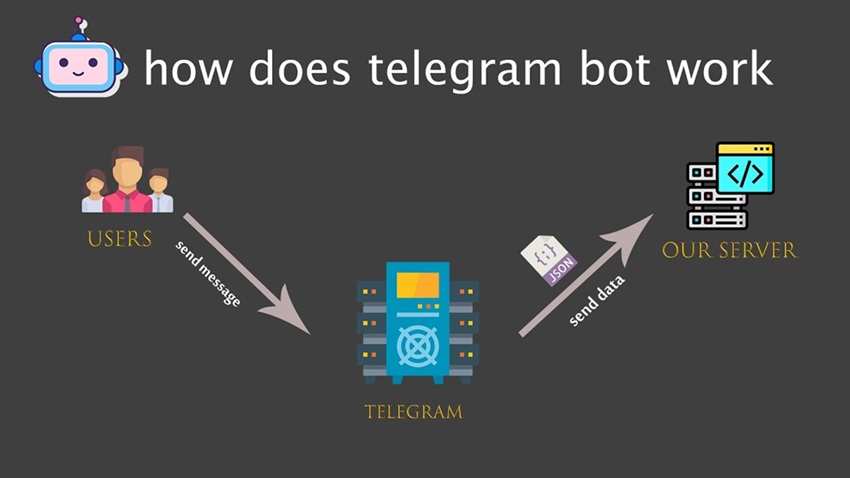
The flow is straightforward:
- You send a message or command to the bot.
- Telegram forwards it to the bot’s backend via the Bot API.
- The bot’s software decides what to do.
- It sends a response (or performs an action).
- Telegram delivers that response to you.
Because the logic lives on the developer’s side, bots can do far more than simple keyword replies. They can look up data, trigger workflows, post to channels, or integrate with payment and notification systems. This is what people mean by Telegram automation: software handling repetitive or structured tasks inside the messaging app.
Common capabilities
- Automated replies and FAQ support
- News and alert delivery
- Group moderation and anti-spam
- Reminders and scheduling
- File handling and simple processing
- Links to websites, databases, or internal tools
- Translation, quizzes, and educational exercises
Legitimate Telegram Bots vs Malicious Bots
Most bots are built for ordinary, useful purposes. The same platform features that make them convenient also attract people who want to scale scams.
Legitimate uses
Customer support — Order status, FAQs, appointment reminders, basic troubleshooting.
News and alerts — Publishers and projects push updates to subscribers without requiring constant app checks.
Community management — Large groups use bots to filter spam, welcome members, run polls, and enforce rules.
Business and internal tools — Notifications, feedback collection, release announcements, and team alerts.
Cryptocurrency communities — Price alerts and project updates are common. (This space also attracts a high volume of scams, so caution is especially important.)
How scammers use Telegram bots
Malicious bots typically aim to build trust quickly, then extract money or credentials. Common patterns include:
- Fake support or “recovery” bots that ask for seed phrases or codes
- Impersonation of exchanges, wallets, or well-known brands
- Phishing flows that send users to fake login pages
- Fake giveaways, investment “opportunities,” or guaranteed-return schemes
- Distribution of malicious files or links
Automation lets attackers handle many conversations at once. The technology is rarely sophisticated; the social engineering is what works.
Telegram Bot Security Risks
Bots themselves are not inherently unsafe. Risk comes from who runs them and what they ask you to do.
Phishing and credential theft
Bots may push fake login pages, request one-time codes, or impersonate support. Urgency (“your account will be locked,” “funds will expire”) is a frequent red flag.
Impersonation
Similar names, copied profile pictures, and claims of “official” status are common. Always confirm official bots through a trusted website or channel rather than profile appearance alone.
Malware and malicious files
Some bots advertise “tools,” documents, or updates that contain malware. Treat unexpected downloads the same way you would treat email attachments from strangers.
Scale and persistence
A single bot can message many users and run continuously. That makes it useful for support — and efficient for spam or coordinated scam campaigns.
For related patterns in messaging-based threats, see our look at Telegram hacking channels in 2026.
Telegram Bots and Privacy
Telegram offers strong privacy features for user-to-user chats, but bots are different. When you interact with a bot, data often leaves Telegram’s direct messaging path and goes to the developer’s servers.
Before you rely on a bot, ask:
- Who operates it?
- Why does it need the information it’s requesting?
- Is there a clear privacy policy?
- Is it linked from an official or otherwise trusted source?
Share only what is necessary. Legitimate services almost never need passwords, recovery phrases, full ID documents, or authentication codes through an unknown bot.
Reducing the personal data you share online in general also limits what can be used against you in targeted scams. Privacy-oriented tools and search habits help; see our notes on DuckDuckGo privacy protection and the broader set of privacy tools.
Public vs Private Bots
Public bots are discoverable and aimed at broad audiences — news, translation, community help, product info.
Private bots are built for specific teams or organizations — internal alerts, workflows, monitoring.
Trust expectations differ. A private company bot used inside a known workplace is a different risk profile from a random public bot that messages you out of the blue.
Telegram Bots, Cryptocurrency, and High-Risk Scams
Crypto communities use bots heavily for alerts and updates. Scammers know this and flood the same spaces with fake support bots, wallet “helpers,” and investment schemes.
Never share seed phrases, private keys, or 2FA codes with any bot. Once assets are moved, recovery is rarely possible. For practical habits around this, see our cryptocurrency operational security guide.
How to Spot a Suspicious Telegram Bot
- It contacts you first without a clear reason
- It promises guaranteed profits or urgent rewards
- It asks for payment before delivering anything of value
- It requests passwords, codes, or recovery phrases
- It uses heavy pressure or fear
- It sends you to unfamiliar websites
- It claims to offer illegal or “too good to be true” services
Treat unexpected bot messages with the same skepticism you apply to unexpected emails or texts.
How to Use Telegram Bots More Safely
- Verify the operator before relying on a bot
- Avoid sharing sensitive personal or financial data
- Never hand over authentication codes or seed phrases
- Skip unexpected file downloads
- Review what permissions a bot receives
- Remove bots you no longer use
- Keep your own Telegram account secured (strong authentication, careful linked devices)
Telegram Bots and Broader Online Research
Researchers sometimes examine public bot behavior as one signal among many when studying scam and malware trends. Telegram is a messaging platform, not a dark-web network, but activity on it can overlap with discussions that also appear in other environments. Understanding the different layers of the internet helps keep those distinctions clear.
Frequently Asked Questions
What is a Telegram bot?
An automated Telegram account controlled by software that can reply to messages, run tasks, and connect to other services through the Bot API.
How do Telegram bots work?
You send a message; Telegram passes it to the bot’s backend; the software processes it and returns a response through Telegram. That is the core of Telegram automation.
Are Telegram bots safe?
Many are legitimate and useful. Safety depends on who runs the bot and what it asks for. Verify sources and never share sensitive credentials.
Can a Telegram bot read my private chats?
A bot only receives what you send it or what its permissions allow in groups/channels where it is added. It does not automatically see unrelated private conversations.
Why do scammers use Telegram bots?
Automation lets them handle many victims at once, run 24/7 “support” scripts, and push phishing links efficiently.
Are Telegram bots part of the dark web?
No. Telegram is a mainstream messaging platform. Some criminal groups misuse bots on it, just as they misuse email or social media, but the bots themselves are not dark-web technology.
Conclusion
Telegram bots are a practical automation layer: helpful for support, alerts, and community management, and equally useful to people running scams at scale. The difference is intent and design, not the underlying API.
If you understand what a bot is, how the automation flow works, what data you are sharing, and the common red flags used by scammers, you can keep the convenience and reduce most of the risk. Verify operators, limit what you share, and treat urgency and credential requests as automatic warning signs.
For more on privacy tools, messaging risks, and safer research habits, explore the resources on Torzle.