Dark Web Identity Fraud Ecosystems: How Underground Identity Abuse, Impersonation & Scams Work
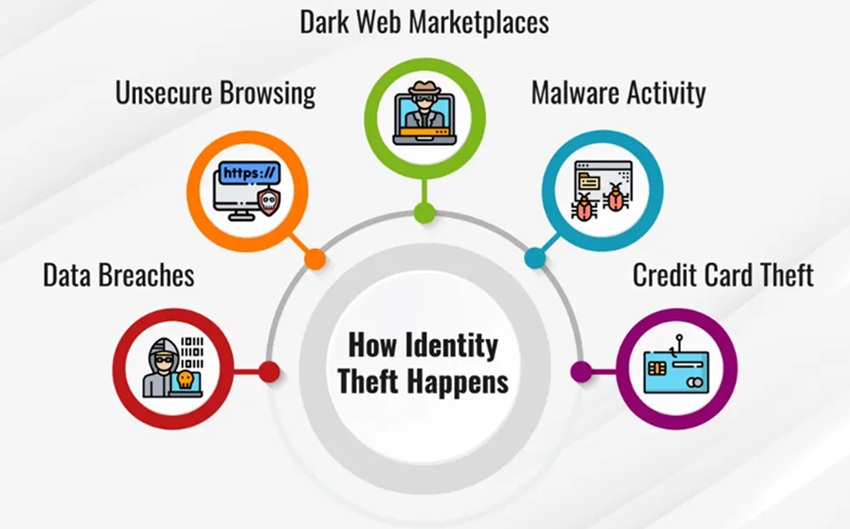
Identity fraud is not simply a matter of one person pretending to be someone else.
Modern identity abuse can involve many connected elements: personal information, compromised credentials, fake profiles, impersonation, social engineering, fraudulent claims and reputation systems.
Some of these elements can appear in underground online environments, where pseudonymous users and marketplace-style systems make it difficult to determine who is behind a claim or whether the information being offered is genuine.
This creates what researchers can describe as an identity fraud ecosystem.
The important point is that an ecosystem is larger than any single listing or actor. Different identity signals can support one another, creating an appearance of credibility even when the underlying information is difficult to verify.
What Is a Dark Web Identity Fraud Ecosystem?
A dark web identity fraud ecosystem is a connected environment in which identity information, credentials, impersonation, fake profiles, deceptive claims and reputation mechanisms may interact.
The term does not mean that every identity-related activity on the dark web is fraudulent. Nor does it mean that every underground listing is genuine.
It is better understood as a research framework.
Instead of looking at one suspicious listing in isolation, researchers can examine the relationships between:
- identity claims;
- personal information;
- credentials;
- fake or compromised profiles;
- impersonation narratives;
- vendor reputation;
- reviews and ratings;
- marketplace guarantees; and
- independent evidence.
Why Identity Fraud Is an Ecosystem Problem
Identity abuse often depends on more than one piece of information.
A name by itself may have limited value. A username by itself may also provide little proof of identity.
But when several identity signals are combined, they can create a stronger appearance of a real person or legitimate account.
This is why researchers should not focus only on the supposed “product” in an underground listing.
The surrounding information can be just as important.
The Main Components of an Identity Fraud Ecosystem
| Component | Possible role | Research question |
|---|---|---|
| Personal information | Identity signal | Where did the information supposedly come from? |
| Credentials | Account-access signal | Can the claim be independently verified? |
| Fake profiles | Manufactured identity or reputation | Does the profile have a credible history? |
| Impersonation claims | Representation of another person or organization | What evidence supports the claimed identity? |
| Reviews | Reputation signal | Are reviewers independent and credible? |
| Vendor history | Continuity signal | Does history establish current identity or control? |
| Guarantees | Trust mechanism | What does the guarantee actually establish? |
Identity Claims Are Not the Same as Identity Evidence
One of the most important distinctions in identity research is the difference between a claim and evidence.
A person may claim to represent a particular individual.
A vendor may claim that information belongs to a specific person.
A profile may appear to have existed for a long time.
None of these observations automatically establishes the underlying identity.
Researchers should ask: What independently supports this claim?
The U.S. Federal Trade Commission describes identity theft as the use of another person's personal or financial information without permission. Its consumer guidance also highlights the importance of monitoring accounts, credit reports and other signs of unauthorized activity.
How Personal Information Becomes an Identity Signal
Identity fraud can involve many types of information.
Depending on the situation, this can include names, addresses, account information, contact details, financial information, login credentials or other identifying data.
The existence of information about a person does not prove that the information was obtained from a legitimate source.
It also does not prove that someone presenting the information is actually the person described.
This distinction becomes especially important in pseudonymous environments.
Pseudonyms Make Identity Continuity Difficult
Underground communities often use aliases rather than verified real-world identities.
A username can develop a reputation over time.
However, a long history under a username does not necessarily establish the real-world identity of the person controlling it.
It also does not automatically prove that the same individual continues to control the account.
Torzle explores this problem in Vendor Identity on the Dark Web: Pseudonyms, Reputation & Continuity Risks .
Fake Profiles Can Manufacture Credibility
A profile can be more than an identity label.
It can also be a credibility signal.
A profile with photographs, posts, history, contacts and positive feedback may appear more convincing than a newly created account.
But appearance is not authentication.
Researchers should ask whether the history is independently supported or whether it simply consists of information generated within the same ecosystem.
This is particularly important when examining fake profile operations and related identity-abuse claims.
Impersonation Relies on Trust
Impersonation works because people make decisions based on identity signals.
A message may appear to come from a colleague, company, customer, family member or trusted service.
The attacker does not necessarily need to reproduce every part of the real identity. They may only need enough information to make the interaction appear believable.
The Cybersecurity and Infrastructure Security Agency describes social engineering as attempts to trick people into revealing information or taking actions that can compromise systems or networks.
This helps explain why identity fraud is closely connected to trust manipulation.
Credential Misuse Is Part of the Larger Picture
Credentials are another important identity signal.
A username and password can indicate access to an account, but they do not necessarily establish who originally created the account, who currently controls it, or how the credentials were obtained.
Researchers should therefore distinguish between:
- an account existing;
- credentials being claimed;
- access being demonstrated;
- identity being established; and
- the origin of the credentials being known.
Torzle's guide on dark web credential misuse can be used as a supporting research topic in this area.
Reputation Can Become Part of the Fraud Model
Underground markets often use familiar trust signals.
These may include ratings, reviews, account age, transaction counts, guarantees or badges.
Such signals can be useful for studying how a marketplace operates.
But they should not automatically be treated as proof of identity.
A highly rated vendor can still make an unverified claim.
A long-standing account can still be pseudonymous.
A large review history can still provide only marketplace-level reputation evidence.
See: Dark Web Vendor Reviews: Why Ratings Aren't Proof of Product Quality or Authenticity .
Why Reviews Can Be Misleading
Reviews can contain useful observations, but researchers should examine their independence and consistency.
Questions worth asking include:
- Are reviews detailed or repetitive?
- Do different accounts appear to use similar language?
- Are negative reviews present?
- How old are the reviews?
- Does the review establish identity or only describe an interaction?
- Are the reviewers independently identifiable?
A collection of reviews may tell researchers about marketplace reputation without proving the truth of the underlying identity claims.
Identity Fraud and Marketplace Deception
Identity-related claims can become part of a broader marketplace deception system.
A seller might claim to have access to a particular identity-related resource.
Another account might provide a positive review.
A marketplace might display a reputation score.
A third-party-looking profile might appear to support the story.
From the outside, these signals can look independent.
Researchers should determine whether they actually are.
The Problem of Circular Evidence
Circular evidence occurs when several sources appear to confirm each other but all originate from the same underlying source.
For example:
| Signal | What it appears to show | Potential limitation |
|---|---|---|
| Vendor profile | Seller has a long history | History may only establish account continuity |
| Customer review | Previous buyer confirms the claim | Reviewer identity may be uncertain |
| Marketplace badge | Platform recognizes the vendor | Badge may not authenticate the underlying claim |
| External-looking profile | Independent identity confirmation | Profile may itself be manufactured |
The lesson is simple: more signals do not always mean more independent evidence.
Identity Abuse Can Cross Platforms
Identity fraud ecosystems are not necessarily contained within one website or marketplace.
A single identity narrative may appear across multiple platforms, profiles or communication channels.
Researchers can therefore look for:
- repeated usernames;
- reused photographs;
- similar descriptions;
- matching claims;
- repeated contact information;
- similar reputation narratives; and
- changes in identity presentation over time.
These observations can help researchers map relationships without interacting with suspected actors.
Identity Verification Is a Separate Question
Researchers should avoid treating identity verification as a single yes-or-no question.
Instead, separate the problem into smaller questions:
- Does the claimed identity correspond to a real person or organization?
- Does the account appear to be associated with that identity?
- Is the person behind the account independently known?
- Is the information current?
- Is the claimed relationship supported by reliable evidence?
Different questions may have different answers.
Why “Verified” Can Mean Different Things
The word “verified” can be especially misleading.
A marketplace might verify that an account completed a particular platform process.
That does not necessarily mean the marketplace independently verified every claim made by the account.
Similarly, a profile badge can indicate a platform status rather than real-world identity authentication.
Researchers should always ask: Verified by whom, and verified for what?
Common Identity Fraud Patterns
Several broad patterns are useful when studying identity-related underground activity.
1. Impersonation
One person or account presents itself as another individual or organization.
2. Manufactured Identity
Information from different sources may be combined to create a seemingly coherent identity.
3. Account Takeover
An existing account may be controlled by someone other than its legitimate owner.
4. Credential Reuse
Compromised credentials may expose identity relationships across multiple services.
5. Reputation Laundering
An account may use reviews, history or other signals to create a stronger appearance of legitimacy.
6. False Documentation Claims
Listings may make claims about identity-related records without providing evidence that independently establishes those claims.
7. Social Engineering
Identity information may be used to make a deceptive message or interaction appear legitimate.
Researchers Should Separate Observation From Interpretation
Good investigative writing makes a clear distinction between what can be observed and what is inferred.
For example:
| Observation | Interpretation |
|---|---|
| A profile uses another person's name. | Possible impersonation. |
| Two accounts use the same photograph. | Possible connection or image reuse. |
| A vendor has hundreds of positive ratings. | Strong marketplace reputation signal. |
| The vendor claims a real-world identity. | Identity claim requiring independent verification. |
This discipline prevents an investigation from turning an interesting clue into an unsupported conclusion.
What Researchers Can Examine Without Participating
Identity fraud research does not require researchers to purchase services or interact with suspected criminals.
A non-participatory approach can examine:
- public reporting;
- archived material;
- observable marketplace structures;
- vendor reputation patterns;
- publicly available identity-fraud guidance;
- repeated claims across sources;
- historical changes in profiles; and
- independent documentation.
This approach is particularly useful when the research question concerns how an ecosystem creates trust rather than how an illicit transaction is completed.
A Simple Evidence Framework
Researchers can classify identity-related claims using four basic categories:
| Status | Meaning |
|---|---|
| Supported | Credible independent evidence supports the important part of the claim. |
| Partially supported | Some aspects are supported, while important details remain uncertain. |
| Unverified | The claim primarily relies on statements from the marketplace or related sources. |
| Contradicted | Reliable evidence conflicts with an important part of the claim. |
“Unverified” is especially important.
It does not mean that a claim is definitely false.
It means that the available evidence is not strong enough to establish the claim as fact.
Identity Fraud vs. Identity Verification
The two concepts are closely related but should not be confused.
Identity fraud concerns misuse or deceptive representation of identity.
Identity verification concerns determining whether an identity claim can be established.
For researchers, the second question is often more practical.
Instead of asking: “Is this person a fraudster?”
Ask: “What evidence establishes the identity being claimed?”
That produces a more defensible investigation.
Why Identity Fraud Claims Can Be Difficult to Verify
Underground environments create several verification problems at once.
- Actors may use pseudonyms.
- Information may be copied from other sources.
- Profiles can be manufactured.
- Historical information may be incomplete.
- Marketplace records may not be independently audited.
- Reviews may be difficult to authenticate.
- Claims can disappear or change over time.
- Different accounts may reinforce the same unsupported narrative.
These limitations make careful wording essential.
Warning Signs Researchers Can Document
Researchers can document potential warning signs without treating any single sign as proof of fraud.
- Repeated use of identical identity descriptions.
- Profiles with unusually polished but unverifiable histories.
- Conflicting identity details.
- Rapid changes to usernames or biographies.
- Photographs appearing across unrelated identities.
- Strong guarantees without clear verification procedures.
- Reviews that repeat similar language.
- Claims that rely almost entirely on marketplace reputation.
- Important identity claims that cannot be independently corroborated.
These are investigative indicators, not automatic proof.
Identity Fraud and Product-Like Search Intent
Identity-related underground markets can attract people searching for a specific service, account, profile or identity-related product.
That search behavior creates a dangerous information gap.
Someone may begin with a product-style question but encounter a marketplace where the most important issue is not availability.
It is whether the claim is genuine at all.
This is why investigative research should focus on:
- authenticity;
- provenance;
- identity verification;
- reputation manipulation;
- impersonation risk; and
- evidence quality.
Torzle's broader research on dark web market risks provides additional context for understanding why underground marketplace claims require caution.
How Researchers Can Map an Identity Ecosystem
Mapping does not require participating in transactions.
Researchers can create a simple relationship map containing:
- usernames;
- claimed identities;
- profiles;
- reputation signals;
- repeated photographs;
- recurring descriptions;
- marketplace references; and
- independent sources.
Each connection should be labelled according to its strength.
A shared username may be a useful clue.
A confirmed independent relationship is stronger.
The key is not to turn every similarity into a proven connection.
What a Responsible Investigation Should Avoid
Investigative research should avoid unnecessary participation in illicit activity.
It should also avoid:
- purchasing identity-related services;
- requesting stolen information;
- testing compromised credentials;
- contacting suspected victims unnecessarily;
- publishing sensitive personal information;
- repeating unverified identity claims as facts; or
- providing instructions that facilitate identity abuse.
The goal is to understand the system without becoming part of it.
How Individuals Can Reduce Identity-Fraud Risk
The investigative picture also has a practical side.
People can reduce risk by limiting unnecessary exposure of personal information, securing important accounts and monitoring for unexpected activity.
The FTC recommends monitoring financial accounts and credit reports and taking action when unfamiliar activity appears. It also recommends using stronger account security, including multi-factor authentication where available.
If identity theft is suspected, official guidance should be used rather than relying on underground forums or unofficial recovery services.
Two Useful Educational References
For general identity-theft protection and recovery guidance, the U.S. Federal Trade Commission's identity theft guidance explains common forms of identity theft, warning signs and protective steps.
For understanding social engineering and credential-related threats, researchers can also consult CISA's phishing and social-engineering guidance .
Conclusion
Dark web identity fraud is best understood as an ecosystem rather than a single activity.
Personal information, credentials, fake profiles, impersonation, vendor reputation and marketplace trust signals can interact to create an appearance of legitimacy.
That appearance can be difficult to separate from reality.
For researchers, the answer is not to accept the strongest claim on the page. It is to break the claim into smaller questions and examine the evidence behind each one.
Who is making the claim?
What does the claim actually establish?
Is the evidence independent?
Can another reliable source corroborate it?
Does the identity remain consistent over time?
And what remains unknown?
Those questions help move identity research away from marketplace persuasion and toward evidence-based investigation.
The most important conclusion is often not that an identity claim is genuine or fraudulent.
It may simply be that the available evidence is not sufficient to verify it.
In underground identity research, recognizing that limitation is a strength—not a failure of investigation.
Frequently Asked Questions
What is a dark web identity fraud ecosystem?
A dark web identity fraud ecosystem is a connected environment in which stolen personal information, credentials, impersonation, fake profiles, fraudulent claims and reputation systems can be used together to support identity-related abuse.
Does the dark web cause identity theft?
Identity theft can occur through many channels. Underground online markets can contribute to the problem by creating places where stolen information, credentials or identity-related claims may be discussed, exchanged or misused.
Can marketplace reputation prove that an identity-related claim is genuine?
No. Ratings, reviews and vendor history are reputation signals. They do not independently prove that an identity, credential, document, profile or other claim is genuine.
Why are fake profiles useful in identity fraud?
Fake profiles can create a false appearance of identity, history or credibility. They may be used to support impersonation, social engineering or deceptive marketplace claims.
What makes underground identity claims difficult to verify?
Researchers may have limited access to original records, uncertain source histories, pseudonymous actors, copied information and claims that cannot be independently corroborated.
Can researchers study identity fraud ecosystems without participating in transactions?
Yes. Researchers can examine public reporting, archived material, observable marketplace patterns, reputation signals and independent sources without purchasing, requesting or facilitating illicit services.