Empire Market: Rise, Exit Scam, Shutdown & What Happened Next
Published by Torzle • Dark Web Research • Updated 2026
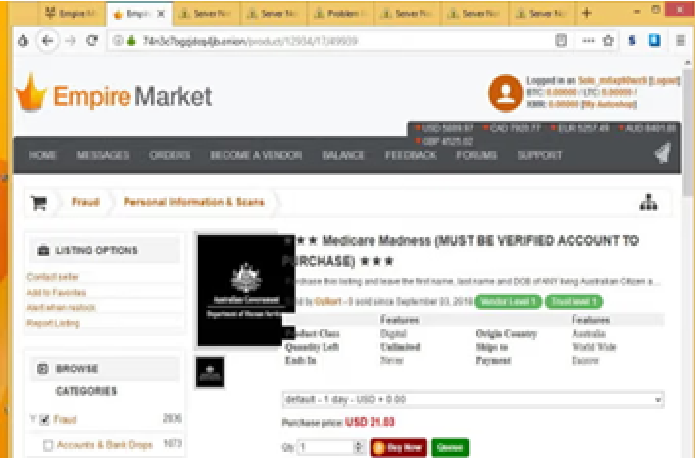
Few names in darknet history are as recognizable as Empire Market. During its peak, the marketplace became one of the largest destinations on the dark web, attracting thousands of vendors and buyers worldwide. After filling the gap left by earlier marketplace closures, Empire Market quickly established a reputation for offering a broad range of listings, an escrow payment system, and support for cryptocurrencies.
Despite its popularity, Empire Market disappeared almost overnight in August 2020. The sudden shutdown triggered years of speculation among cybersecurity researchers, journalists, law enforcement agencies, and former users. Some believed the operators conducted one of the largest Empire Market exit scams ever recorded, while others suspected an ongoing law enforcement operation behind the scenes. Even years later, investigations continue to reveal new details about individuals allegedly connected to the marketplace.
This article explains Empire Market in simple terms, explores its rise and fall, examines the latest legal developments, and discusses why its story still matters today. Whether you are researching darknet history, cybersecurity, or anonymous technologies, understanding Empire Market provides valuable insight into how modern dark web market ecosystems evolve and eventually collapse.
What You Will Learn
What Empire Market was and why it became so popular.
How Empire Market reshaped the dark web marketplace landscape.
Why Empire Market suddenly disappeared in 2020.
Theories surrounding the alleged exit scam.
Recent law enforcement actions and legal proceedings.
How today's darknet markets compare with Empire Market.
Empire Market Explained
For readers unfamiliar with darknet marketplaces, Empire Market was a hidden service accessible only through the Tor network. Like many darknet platforms before it, the marketplace was designed to allow anonymous communication between buyers and vendors using encrypted connections and cryptocurrency payments.
Unlike ordinary websites that appear in traditional search engines, Empire Market operated as an onion service. Users generally relied on trusted directories, verified links, and specialized search tools to locate its address. If you are interested in understanding how onion websites work, our guide explaining the different parts of the internet provides an excellent starting point.
Empire Market launched during a period when several well-known darknet markets had already disappeared. Users were actively searching for a stable replacement, and Empire Market filled that demand by offering a familiar interface, vendor reputation systems, encrypted messaging, escrow services, and support for Bitcoin and Monero.
The marketplace rapidly expanded into one of the largest communities operating on the Tor network. Vendors from numerous countries created storefronts while buyers used the platform for a variety of listings. Although darknet markets often advertise anonymity, they remain attractive targets for cybersecurity researchers and international law enforcement agencies.
Empire Market History
Understanding Empire Market history helps explain why the platform became so influential. The marketplace first appeared in early 2018 following the closure of several major darknet markets. At the time, many experienced vendors were searching for a reliable platform to continue operating.
Empire Market adopted features that users had already become familiar with on earlier marketplaces. Vendor ratings, dispute resolution, escrow payments, two-factor authentication, and PGP-encrypted messaging all helped establish trust within an environment where participants rarely knew each other's identities.
PGP encryption played an important role in protecting communications between buyers and vendors. If you're new to encrypted messaging, our PGP Encryption Basics guide explains how public-key encryption works and why it remains widely used throughout privacy-focused communities.
As its reputation grew, Empire Market reportedly attracted thousands of active vendors and hundreds of thousands of registered accounts. Its administrators regularly promoted security practices and encouraged users to enable additional authentication measures to protect their accounts.
While Empire Market became known primarily as a darknet marketplace, cybersecurity professionals also monitored the platform to understand criminal trends, cryptocurrency movement, operational security failures, and emerging cyber threats. Researchers studying the evolution of darknet ecosystems often cite Empire Market as one of the defining marketplaces of its era.
Empire Market and the Dark Web
Many people use the terms dark web, deep web, and Tor network interchangeably, but they are not the same thing. The dark web represents only a small portion of the internet that requires specialized software such as the Tor Browser to access hidden services ending in .onion.
Empire Market operated entirely within this environment. Visitors generally reached the marketplace through verified onion addresses rather than ordinary domain names. Because onion addresses frequently changed, users depended on trusted directories and search engines that indexed Tor services.
If you are researching privacy-focused search tools, you may find our guide to the Torch Search Engine helpful. You can also learn about another well-known onion search platform by reading our article on the Haystack Search Engine.
Researchers also rely on platforms such as Excavator Tor Search when studying publicly available onion services and monitoring changes across the Tor ecosystem. Resources like these are valuable for cybersecurity professionals, journalists, and academic researchers who analyze darknet activity without participating in illegal marketplaces.
Modern platforms increasingly incorporate dark web AI technologies to organize publicly available intelligence, identify infrastructure changes, detect phishing campaigns, and analyze large collections of darknet data. While artificial intelligence has become a useful research tool, it does not eliminate the need for careful human verification when investigating darknet content.
Why Empire Market Grew So Quickly
Several factors contributed to the rapid success of Empire Market. First, the marketplace appeared during a period of uncertainty after the disappearance of several competing darknet platforms. Thousands of displaced users were actively searching for a new marketplace with familiar features and an established reputation.
Second, the platform invested heavily in user experience. Compared with earlier marketplaces, Empire Market offered improved navigation, detailed vendor profiles, customer feedback systems, and multilingual support. These features made it easier for experienced users to transition from previous marketplaces.
Third, cryptocurrency adoption continued growing throughout this period. Bitcoin remained widely accepted, while Monero became increasingly popular because of its stronger privacy characteristics. Combined with encrypted communication through PGP and access through the Tor Browser, many users believed these technologies provided greater anonymity than traditional online services.
Finally, Empire Market benefited from reputation. Vendors with long transaction histories attracted repeat customers, while escrow services reduced some risks associated with anonymous transactions. These trust mechanisms encouraged continued growth despite the inherent uncertainty of operating within anonymous online environments.
Important Note
This article is intended for educational, historical, and cybersecurity research purposes only. It does not encourage, promote, or facilitate illegal activity. Understanding the history of darknet marketplaces helps researchers, journalists, and security professionals analyze cybercrime trends, online anonymity technologies, and law enforcement investigations.
However, Empire Market's remarkable growth would eventually be overshadowed by unexpected downtime, widespread rumors, and one of the most debated disappearances in darknet history. In the next section, we'll examine how Empire Market went dark in 2020, explore the competing theories behind its disappearance, and answer one of the internet's most frequently asked questions: What happened to Empire Market?
Empire Market Went Dark in 2020
By mid-2020, Empire Market had become one of the most recognized darknet marketplaces operating on the Tor network. Thousands of users logged in daily, vendors maintained established reputations, and cryptocurrency transactions continued to flow through the platform. From the outside, Empire Market appeared to be thriving. Behind the scenes, however, users had begun reporting increasing technical problems.
Beginning in July 2020, the marketplace experienced repeated outages. Users frequently encountered timeout errors, login failures, and inaccessible onion addresses. Administrators attributed the interruptions to large-scale distributed denial-of-service (DDoS) attacks targeting the marketplace's infrastructure. Temporary outages had occurred before, so many users initially accepted these explanations.
Weeks passed with little improvement. Although administrators occasionally announced that services would soon return to normal, the interruptions became longer and more frequent. Vendors struggled to communicate with customers, while buyers found themselves unable to access escrow funds or complete pending transactions.
On or around August 2020, Empire Market disappeared entirely. The onion addresses stopped responding, official communication channels fell silent, and administrators never issued a confirmed public explanation. Unlike some previous darknet marketplaces that displayed seizure banners after coordinated law enforcement actions, Empire Market simply vanished.
That disappearance marked the beginning of one of the biggest mysteries in darknet history. To this day, discussions continue regarding exactly why the marketplace went offline and what became of its operators.
What Happened to Empire Market?
The question "What happened to Empire Market?" continues to appear in cybersecurity forums, research papers, and online discussions years after the shutdown. While there is no universally accepted explanation for the marketplace's disappearance, several theories have emerged based on available evidence.
Theory 1: An Exit Scam
The most widely discussed explanation is that Empire Market's administrators conducted a large-scale Empire Market exit scam. An exit scam occurs when marketplace operators suddenly shut down a platform while retaining cryptocurrency held in escrow on behalf of buyers and vendors.
Escrow systems are designed to protect both parties during transactions. Instead of sending cryptocurrency directly to a vendor, funds remain temporarily under the marketplace's control until a transaction is completed. If administrators disappear while holding those funds, users often have little chance of recovering their assets.
Following Empire Market's disappearance, many vendors claimed they lost significant cryptocurrency balances that remained locked in escrow accounts. Estimates varied widely because the marketplace's internal financial records were never made public. Regardless of the exact amount, many members of the darknet community concluded that an exit scam had likely occurred.
Theory 2: Technical Failure
Some researchers suggested that prolonged infrastructure failures could have contributed to the shutdown. Maintaining a large hidden service requires constant attention to security, server availability, and protection against denial-of-service attacks. Empire Market reportedly faced repeated attacks during its final weeks, raising the possibility that administrators simply lost control of their infrastructure.
While technically possible, this theory became less convincing as administrators never returned to restore services or communicate with users after the disappearance.
Theory 3: Law Enforcement Pressure
Another theory proposed that law enforcement agencies had already infiltrated parts of the marketplace or were preparing enforcement actions behind the scenes. Rather than waiting for arrests, administrators may have decided to abandon the platform before investigators gathered sufficient evidence.
Years later, criminal charges filed against individuals allegedly connected to Empire Market renewed interest in this possibility. Although those legal proceedings do not fully explain the 2020 disappearance, they demonstrate that investigators continued examining the marketplace long after it went offline.
The Empire Market Exit Scam Debate
Among cybersecurity researchers, the phrase Empire Market exit scam remains one of the most debated topics surrounding the marketplace. Unlike marketplaces that publicly announce closure or experience confirmed law enforcement seizures, Empire Market disappeared without any official explanation.
Several observations strengthened the exit scam theory:
Administrators stopped communicating with users.
Escrow balances reportedly became inaccessible.
No official seizure notice appeared on the marketplace.
No verified administrator returned to explain the shutdown.
Multiple backup onion addresses also became unavailable.
On the other hand, researchers caution that these observations alone cannot conclusively prove an exit scam. Without direct evidence from the operators, the exact sequence of events remains uncertain. The later criminal investigation focused primarily on alleged marketplace operations rather than providing a complete explanation for the final shutdown.
How the Shutdown Changed the Dark Web Market Landscape
Empire Market's disappearance created a significant power vacuum across the darknet ecosystem. Thousands of vendors suddenly needed new platforms, while buyers searched for marketplaces that appeared trustworthy. History had already shown that major marketplace closures often trigger rapid migration toward newer platforms.
Several darknet markets attempted to attract former Empire Market users by advertising similar features, including escrow systems, cryptocurrency support, and vendor reputation programs. However, many users had become increasingly skeptical after witnessing repeated marketplace collapses over the previous decade.
The shutdown also reinforced an important lesson within darknet communities: no marketplace, regardless of its popularity or reputation, should be considered permanent. Every platform eventually faces technical challenges, operational mistakes, internal conflicts, law enforcement attention, or financial incentives that can lead to sudden closure.
Empire Market Alternatives (Historical)
After Empire Market disappeared, former users migrated to several other darknet marketplaces. These platforms should be viewed as part of darknet history rather than recommendations. Like Empire Market itself, many later experienced seizures, shutdowns, scams, or other disruptions.
Some marketplaces that received increased attention after Empire Market's disappearance included:
White House Market
DarkMarket
Versus Market
Cannazon Market
ToRReZ Market
Each marketplace introduced its own security policies, cryptocurrency requirements, and operational practices. Nevertheless, the overall pattern remained remarkably consistent: marketplaces appeared, gained popularity, encountered increasing operational pressure, and eventually disappeared.
For cybersecurity researchers, these repeated cycles demonstrate the unstable nature of anonymous criminal marketplaces and the ongoing efforts by law enforcement agencies worldwide to disrupt them.
Empire Market vs Styx Market
As newer darknet markets emerged, comparisons naturally followed. One name that has recently attracted attention within cybersecurity discussions is Styx Market. Although both Empire Market and Styx Market are discussed within the broader context of darknet marketplaces, they represent different periods in the evolution of the darknet ecosystem.
Empire Market rose to prominence between 2018 and 2020, becoming one of the largest marketplaces of its time before disappearing unexpectedly. Styx Market, by contrast, belongs to a newer generation of darknet markets that developed after many earlier platforms had already collapsed.
When comparing Empire Market vs Styx Market, researchers often focus on operational security, marketplace design, cryptocurrency preferences, user verification systems, and resistance to infrastructure attacks. While technology has evolved, one lesson remains unchanged: every darknet marketplace operates under constant technical, financial, and legal pressure.
Cybersecurity professionals generally study these platforms to understand trends rather than individual marketplaces. The evolution from Silk Road to AlphaBay, Dream Market, Empire Market, and later platforms illustrates how darknet ecosystems continually adapt to changing technologies and law enforcement strategies.
The Growing Role of Dark Web AI Research
One major difference between the era of Empire Market and today's cybersecurity landscape is the increasing use of dark web AI. Modern researchers use artificial intelligence to organize publicly available darknet information, identify infrastructure changes, detect phishing campaigns, analyze cryptocurrency patterns, and monitor emerging cyber threats more efficiently than ever before.
Rather than manually reviewing thousands of onion services, analysts can use AI-assisted research tools to prioritize relevant findings, identify suspicious activity, and discover relationships across publicly available datasets. Human expertise remains essential, but AI has become a valuable addition to modern threat intelligence workflows.
The history of Empire Market continues to provide important training data for cybersecurity professionals studying operational security failures, marketplace behavior, cryptocurrency investigations, and law enforcement strategies. Lessons learned from its rise and sudden disappearance continue to influence research into today's evolving dark web market ecosystem.
In the final part of this article, we'll examine the law enforcement investigation, recent legal proceedings against the alleged operators, background on cryptocurrency seizures, and why the Empire Market story still matters to cybersecurity researchers today.
Law Enforcement and Legal Proceedings
For several years after Empire Market disappeared, relatively little official information was released about the people believed to be behind the marketplace. While rumors circulated across darknet forums and social media, investigators continued gathering evidence through international cooperation, cryptocurrency tracing, digital forensics, and financial investigations.
Years later, authorities announced criminal charges against individuals alleged to have operated Empire Market. According to court documents, investigators believe the marketplace facilitated hundreds of millions of dollars in illegal transactions during its years of operation. The charges renewed worldwide interest in the marketplace and answered some long-standing questions about its administration, although many aspects of the 2020 shutdown remain unknown.
The investigation involved multiple agencies working across different jurisdictions. Modern cybercrime investigations often require cooperation between national police organizations, financial intelligence units, customs authorities, and digital forensic specialists because darknet marketplaces rarely operate within a single country.
Unlike the early days of darknet investigations, today's law enforcement agencies possess far more advanced tools for tracing cryptocurrency transactions, analyzing seized devices, identifying operational security mistakes, and reconstructing communication histories. These capabilities have significantly improved the ability to investigate complex online criminal enterprises.
Background and Seizures
The investigation into Empire Market reflects broader trends seen throughout darknet enforcement operations over the past decade. When investigators target a major marketplace, they typically focus on far more than simply taking a website offline. Their objectives often include identifying administrators, tracing cryptocurrency assets, gathering digital evidence, and disrupting supporting infrastructure.
Cryptocurrency plays a central role in many darknet investigations. Although digital currencies provide varying degrees of privacy, blockchain analysis has become an increasingly valuable investigative technique. Analysts can often identify transaction patterns, connect wallets, and follow funds as they move between services and exchanges.
Digital evidence extends well beyond cryptocurrency. Investigators may examine server configurations, communication records, backups, hosting infrastructure, authentication logs, operational security mistakes, and seized electronic devices. Individually these pieces of evidence may appear insignificant, but together they can help reconstruct the operation of an online marketplace.
History has repeatedly demonstrated that maintaining anonymity over many years is extremely difficult. Small operational mistakes—including reused usernames, improperly secured servers, metadata leaks, or financial errors—can eventually provide investigators with valuable leads.
This pattern has appeared in numerous darknet investigations and serves as a reminder that operational security requires constant attention. Even experienced administrators can make mistakes that become significant years later during a criminal investigation.
Why This Matters Now
Although Empire Market disappeared in 2020, its story remains highly relevant today. Cybersecurity professionals, journalists, researchers, and students continue studying the marketplace because it illustrates the evolving relationship between anonymity technologies, cryptocurrency, cybercrime, and international law enforcement.
The investigation also highlights how cybercrime cases can continue for years after a website disappears. Shutting down a marketplace does not necessarily end an investigation. Digital evidence often remains available long after servers go offline, allowing investigators to continue building cases over extended periods.
For cybersecurity researchers, Empire Market demonstrates how technological innovation creates both opportunities and challenges. Privacy technologies such as Tor, encrypted messaging, and cryptocurrency have legitimate uses that support journalists, activists, researchers, and ordinary users seeking greater online privacy. At the same time, these technologies may also be misused for illegal activities.
Understanding this distinction is essential. The technologies themselves are not inherently unlawful. Instead, their impact depends on how individuals choose to use them. This balanced perspective helps explain why privacy research and cybersecurity education remain important topics.
Lessons from Empire Market
Empire Market's history offers several important lessons for researchers and cybersecurity professionals.
No darknet marketplace lasts forever. Every major marketplace eventually encounters operational, financial, technical, or legal challenges.
Trust is temporary. Even marketplaces with strong reputations can disappear without warning.
Operational security matters. Small mistakes made over months or years may eventually contribute to successful investigations.
Cryptocurrency is traceable. Modern blockchain analysis has become an important investigative resource.
International cooperation continues to expand. Cybercrime investigations increasingly involve multiple countries working together.
These lessons extend beyond Empire Market itself and apply to many major darknet investigations throughout the past decade.
The Future of the Dark Web Market Ecosystem
The disappearance of one marketplace rarely signals the end of darknet activity. Instead, new platforms often emerge, introducing updated features, different cryptocurrencies, revised security models, and new administrative structures. This continual cycle has characterized the darknet ecosystem for many years.
Today's dark web market landscape differs considerably from the environment in which Empire Market operated. Administrators increasingly emphasize operational security, while researchers and law enforcement agencies continue improving investigative techniques. At the same time, artificial intelligence has become an important tool for organizing publicly available information and identifying cyber threats.
The growing use of dark web AI allows analysts to examine large volumes of publicly available darknet content more efficiently than was possible during Empire Market's operation. AI-assisted research can help identify phishing campaigns, infrastructure changes, malware discussions, and emerging cyber threats, although human expertise remains essential for interpreting findings accurately.
Researchers expect both defensive technologies and investigative capabilities to continue evolving. As privacy technologies improve, investigative methods also become more sophisticated, creating an ongoing cycle of adaptation between cybercriminals and law enforcement agencies.
Frequently Asked Questions
What was Empire Market?
Empire Market was a darknet marketplace that operated on the Tor network between 2018 and 2020. It became one of the largest online marketplaces of its time before suddenly disappearing.
What happened to Empire Market?
The marketplace went offline in August 2020 after weeks of instability. Its operators never publicly explained the shutdown. Many researchers believe an exit scam occurred, while others have suggested technical failures or law enforcement pressure may have contributed.
Was Empire Market seized by law enforcement?
Unlike some previous darknet marketplaces, Empire Market did not display an official seizure notice when it disappeared. Years later, authorities announced criminal charges against individuals alleged to have operated the marketplace, but the exact circumstances surrounding the 2020 shutdown remain uncertain.
What is the Empire Market exit scam?
The phrase refers to the widely discussed theory that administrators allegedly disappeared while retaining cryptocurrency held in escrow accounts. Although this explanation is commonly referenced, the complete details have never been officially confirmed.
What are the historical alternatives to Empire Market?
Following Empire Market's disappearance, users migrated to several other darknet marketplaces. Many of those platforms also experienced shutdowns, seizures, or operational failures, illustrating the continually changing nature of the darknet ecosystem.
Conclusion
Empire Market remains one of the most significant chapters in darknet history. Its rapid rise demonstrated how quickly online marketplaces could grow when users sought trusted alternatives, while its sudden disappearance highlighted the uncertainty that has always surrounded anonymous online platforms.
Years after the marketplace vanished, ongoing investigations and legal proceedings continue providing new insight into its operation and alleged administrators. The case also illustrates how modern cybercrime investigations increasingly rely on blockchain analysis, international cooperation, digital forensics, and long-term investigative strategies.
For cybersecurity professionals, journalists, students, and privacy researchers, Empire Market represents more than the story of a single darknet marketplace. It serves as a case study in operational security, digital investigations, cryptocurrency tracing, and the constantly evolving relationship between privacy technologies and law enforcement.
At Torzle, our goal is to provide educational resources that explain complex cybersecurity topics in clear, accessible language. Whether you're exploring darknet history, learning about privacy technologies, or researching emerging cybersecurity trends, understanding the rise and fall of Empire Market offers valuable perspective on one of the internet's most closely watched underground marketplaces.