Dread Dark Web Discussion Forum: History, Purpose, Safety & How It Worked
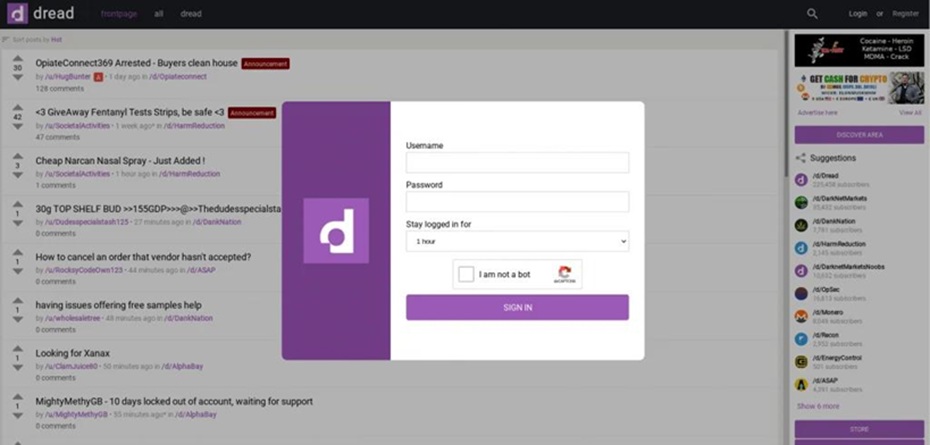
The Dread dark web discussion forum became one of the most recognizable discussion communities associated with the Tor network. Often described as a Reddit-like forum for the dark web, Dread provided a place where users could publish posts, comment on discussions, exchange information, report scams, discuss security issues, and follow developments affecting darknet markets.
Dread is particularly interesting from a cybersecurity and research perspective because it demonstrates how online communities can form around anonymity, pseudonymous identity, reputation systems, and information sharing. At the same time, the forum became associated with discussions involving illegal markets and criminal activity, making it important to distinguish legitimate cybersecurity research from participation in unlawful activity.
This article examines the history and purpose of Dread, how its discussion model worked, why it became influential, the security and privacy risks associated with anonymous forums, and what researchers and ordinary internet users can learn from its history.
What Was the Dread Dark Web Discussion Forum?
Dread was a discussion forum hosted through the Tor network. Its interface and organization were commonly compared with Reddit because users could create posts, participate in threaded discussions, and interact within topic-focused communities.
The forum became closely associated with darknet-market discussions, but describing Dread simply as a marketplace would be inaccurate. Its primary function was communication. Users discussed news, marketplace activity, scams, security, privacy, disputes, technical subjects, and developments affecting anonymous online communities.
Academic research has also examined Dread as an example of an underground online community. Researchers have used archived or collected forum material to study subjects such as information sharing, social trust, criminal innovation, and community behavior.
This distinction matters. A discussion forum can influence an ecosystem without directly providing the transactional infrastructure associated with a marketplace. In Dread's case, information itself was one of the most important resources.
History of Dread
Dread emerged in 2018, during a period of major disruption within online darknet communities. One of the most important events preceding its rise was Reddit's removal of the popular /r/DarkNetMarkets community in March 2018.
The removal created a significant information gap. People who had previously used conventional web platforms to discuss darknet-market developments needed other places to communicate. Dread subsequently emerged as one of the most prominent alternatives.
2018: Rapid Growth
Dread grew quickly after launch. Contemporary accounts describe thousands of users joining during its early months, helping establish the forum as a central discussion point for darknet-related information.
Its growth illustrates an important principle in online-community formation: when an established community disappears, members often migrate toward a platform that reproduces familiar social functions.
2019: Disruption and Recovery
Dread experienced serious operational disruption in 2019. A period of downtime generated considerable speculation about what had happened, while later explanations attributed the incident to technical problems rather than establishing that the service had been compromised by law enforcement.
The episode demonstrated one of the fundamental weaknesses of centralized anonymous communities: anonymity does not eliminate infrastructure dependency. Servers, software, administrators, hosting arrangements, and network availability can all become points of failure.
Later Years: Attacks and Availability Problems
Dread subsequently experienced additional periods of downtime and denial-of-service pressure. Such attacks are a recurring problem for onion services because keeping a popular anonymous service reachable while resisting traffic floods can be technically difficult.
These disruptions became part of Dread's history and helped demonstrate why availability is itself a major security property. A service can preserve confidentiality while still failing its users because legitimate visitors cannot reach it.
Why Was Dread Created?
Dread can be understood partly as a response to the fragmentation of darknet-related discussion communities.
Before Dread, discussions could occur across public websites, specialist forums, marketplace communities, news sites, and social-media platforms. When major platforms removed communities associated with darknet markets, users increasingly looked for dedicated alternatives.
Dread offered a structure designed around anonymous discussion rather than conventional social-media identity. That distinction was important because pseudonymous participation was central to the community's culture.
The broader concept of the dark web is explained in more detail in this dark web overview, which provides useful context before examining individual forums.
The Information-Hub Model
Dread's significance was largely based on its role as an information hub. A forum can become influential when its members collectively monitor events and rapidly distribute information.
Examples of information discussed in such environments can include:
- Announcements concerning online communities
- Reports of scams or suspicious behavior
- Security and privacy discussions
- Technical problems and service outages
- Reactions to law-enforcement activity
- Changes affecting anonymous online services
- General cybersecurity discussions
The same information-sharing mechanism that makes a community useful to researchers can also make it useful to malicious actors. That dual-use characteristic is one reason dark-web communities require careful analysis.
How the Dread Forum Worked
At a high level, Dread operated like a conventional discussion forum but used the Tor network to provide an anonymous-access environment.
The basic model was straightforward:
- A user created or accessed a pseudonymous account.
- Users participated in topic-specific communities.
- Members published posts and other users responded.
- Reputation signals helped communities evaluate contributors.
- Moderators managed discussions and enforced forum rules.
This model is not fundamentally different from many conventional social platforms. The major difference was the surrounding anonymity infrastructure and the types of subjects being discussed.
Sub-Communities
Dread used topic-focused areas sometimes referred to as subdreads. This organization allowed large numbers of conversations to be separated by subject.
Topic segmentation is useful because large communities quickly become difficult to navigate. A specialized section can develop its own norms, moderators, terminology, reputation systems, and recurring contributors.
Reputation and Trust
Reputation was particularly important in an environment where conventional identity verification was limited.
When users cannot easily establish who another person really is, communities often develop alternative trust signals. Account history, writing consistency, community reactions, moderator decisions, and previous claims may all influence perceived credibility.
However, reputation is not proof of identity or truth. A long-lived account can be compromised, a respected account can be impersonated, and coordinated manipulation can create misleading consensus.
Community Structure and Discussion
One reason Dread attracted attention from researchers was the diversity of subjects discussed within a single anonymous environment.
Research examining Dread has identified communities and discussions involving darknet markets, hacking, fraud, identity theft, drugs, privacy, and security. This makes the forum useful as a case study in how different underground communities can overlap.
Information Flow
Information on forums such as Dread can move rapidly through several stages:
- A user makes an initial claim.
- Other users challenge or support the claim.
- Additional users provide screenshots, links, or commentary.
- Moderators may intervene when disputes become significant.
- The community gradually develops a consensus.
The final consensus may or may not be correct. This is an important distinction for researchers. A large number of comments agreeing with a claim does not independently verify that claim.
Moderation
Moderation is another essential component of anonymous communities. Even forums that emphasize freedom of expression need mechanisms for handling spam, impersonation, harassment, scams, malicious links, and disputes.
Moderation also creates a governance problem: administrators must balance openness with abuse prevention while maintaining the community's trust.
Why Dread Became Important
Dread's importance came from a combination of timing, community migration, anonymity, and information density.
It appeared when established darknet discussion communities were disappearing. Rather than attempting to recreate a conventional social network, Dread concentrated on the communication requirements of an anonymous audience.
Over time, this created a feedback loop:
- More users created more discussions.
- More discussions attracted more readers.
- More readers increased the value of useful information.
- More useful information encouraged users to return.
- Returning users increased the community's institutional memory.
This is a familiar network effect. It can be observed on mainstream platforms as well, although the anonymous environment changes how identity and trust function.
Dread as an Information Archive
Another important characteristic was historical continuity. When discussions remain accessible over time, researchers can study how terminology, concerns, scams, technologies, and community attitudes change.
This is one reason researchers have analyzed forum data spanning multiple years. Longitudinal data can reveal trends that would be difficult to observe from isolated incidents.
Dread Compared With Other Online Communities
Dread is best understood as a discussion platform rather than simply as a component of the darknet marketplace infrastructure.
| Feature | Dread | Traditional Forum | Social Network | Darknet Marketplace |
|---|---|---|---|---|
| Primary purpose | Anonymous discussion | Discussion and community | Social interaction | Transactions |
| Identity model | Pseudonymous | Usually pseudonymous or real-name | Often identity-based | Usually pseudonymous |
| Typical content | Discussion, news, community information | Topic-specific discussion | Mixed social content | Listings and transactions |
| Reputation | Community-based | Community-based | Profile and engagement based | Vendor/customer based |
| Anonymous network | Tor-associated | Usually no | Usually no | Often Tor-associated |
| Primary research value | Community and information analysis | Social behavior | Social behavior and trends | Underground-economy analysis |
Security and Privacy Risks
Anonymity should never be confused with complete safety. The dark web can reduce certain forms of direct visibility, but it does not eliminate technical, social, financial, or legal risks.
1. Phishing
Anonymous communities can be attractive targets for phishing because users may rely heavily on links, aliases, reputation claims, and unofficial announcements. Attackers can imitate administrators, moderators, researchers, or trusted community members.
2. Malware
Unknown downloads and malicious websites can expose users to malware. A technically anonymous network does not make an infected device safe.
3. Impersonation
A username does not prove who is behind an account. An attacker can copy an established identity, imitate writing style, or use a compromised account to make fraudulent claims.
4. Deanonymization
Anonymity can fail through operational mistakes, software vulnerabilities, account reuse, browser configuration errors, metadata leakage, payment trails, social engineering, or other investigative techniques.
Anyone researching privacy should also understand the broader differences between internet layers. Torzle's guide to the different parts of the internet provides useful background.
5. Legal Risk
The legality of accessing, possessing, sharing, or purchasing particular content or services varies by jurisdiction. Some dark-web communities contain material associated with serious criminal activity.
Readers should therefore treat this article as cybersecurity and historical research, not as instructions for participating in illegal markets or activities.
Dread and Cybersecurity Research
Dread has considerable value as a research subject because it provides an example of how trust and information-sharing systems develop under conditions of pseudonymity.
Researchers have examined forum data to understand topics such as criminal innovation, social relationships, information exchange, fraud, and changing community interests.
Dark-web monitoring can also help researchers identify emerging narratives and cybersecurity developments. For readers interested in this field, Torzle's article on monitoring darknet tool chatter provides additional context.
What Researchers Can Learn
- How online communities establish trust without conventional identity.
- How terminology changes over time.
- How scams spread through social networks.
- How communities react to platform disruption.
- How criminal and technical discussions can overlap.
- How reputation influences information sharing.
- How online communities respond to law-enforcement events.
Information Verification Matters
Forum content should be treated as an unverified source unless independently corroborated. A post may represent an honest observation, a rumor, an attempt to manipulate the community, or deliberate misinformation.
Strong research therefore compares forum observations with independent reporting, technical evidence, academic studies, public records, and other reliable sources.
Dread in the Wider Dark-Web Ecosystem
Dread did not exist in isolation. It formed part of a broader ecosystem containing anonymous communication services, search tools, marketplaces, privacy communities, security researchers, journalists, and law-enforcement monitoring.
Understanding this ecosystem requires separating several concepts that are frequently mixed together.
Dark Web vs. Deep Web
The deep web generally refers to online content that is not indexed by conventional search engines, including private databases and account-protected services. The dark web is a smaller portion of the internet that requires specialized technologies or configurations to access.
These terms are therefore not interchangeable.
Search and Discovery
Search engines associated with privacy networks have historically played different roles from discussion forums. A search service helps users locate information, while a forum creates a social environment where people produce and debate information.
For background, readers can explore the Tor search-engine overview, Ahmia search information, and the Haystak search-engine article.
These resources should be viewed as educational explanations of search and indexing, not as recommendations for accessing illegal services.
Responsible Dark-Web Research
Studying Dread and similar communities can be valuable for cybersecurity, journalism, criminology, threat intelligence, and academic research. The safest approach is to focus on publicly documented information and avoid unnecessary interaction with criminal services.
Use a Clear Research Question
Begin by defining what you want to understand. A research question such as "How do anonymous communities establish trust?" is substantially safer and more useful than attempting to explore unknown services without a defined objective.
Separate Observation From Participation
Researchers should distinguish passive observation from interaction. Participating in transactions, requesting prohibited material, encouraging criminal activity, or exchanging operational instructions can introduce significant legal and ethical risks.
Protect Research Data
Collected material may contain usernames, personal information, malicious links, criminal content, or other sensitive data. Researchers should minimize collection, follow applicable laws and institutional policies, and protect stored material.
Understand Your Threat Model
Privacy tools are useful only when they are used with a realistic understanding of their limitations. Readers interested in general privacy can also review this overview of privacy tools and Torzle's guide to privacy protection applications.
No privacy tool can guarantee complete anonymity.
Frequently Asked Questions About the Dread Dark Web Discussion Forum
What was the Dread dark web discussion forum?
Dread was a Tor-based discussion forum that became a major meeting point for conversations about darknet markets, online privacy, scams, security, and other subjects associated with anonymous online communities.
When was Dread created?
Dread emerged in 2018. Its growth followed major disruption to established darknet-related discussion communities on mainstream platforms.
Was Dread a darknet marketplace?
No. Dread was primarily a discussion and information-sharing forum rather than a conventional marketplace. Its influence came largely from community discussion, reputation, news, reviews, and information exchange.
Why did Dread become popular?
Dread appeared when other darknet discussion communities were disappearing. Its Reddit-like structure, pseudonymous environment, topic-focused communities, and emphasis on information sharing helped it attract users.
Was Dread completely anonymous?
No. Tor and pseudonymous accounts can improve privacy, but anonymity is never guaranteed. Technical mistakes, account reuse, malware, social engineering, metadata, compromised accounts, and investigative techniques can all undermine anonymity.
Is the dark web safe?
The dark web should not be considered inherently safe. Users can encounter phishing, malware, scams, malicious actors, illegal material, privacy threats, and legal risks.
Can information on Dread be trusted?
Not automatically. Anonymous forums can contain misinformation, impersonation, scams, manipulated reputation signals, and deliberately misleading claims. Important information should be independently verified.
Why do cybersecurity researchers study Dread?
Dread provides a case study in anonymous online communities, trust formation, information sharing, criminal innovation, reputation systems, and community responses to disruption.
Can researchers study dark-web forums legally?
Research legality depends on jurisdiction, the material involved, and what the researcher does with it. Researchers should follow applicable laws, institutional policies, ethics requirements, and data-protection rules.
Conclusion
The Dread dark web discussion forum is significant because it shows how an online community can develop around pseudonymous identity, information sharing, reputation, and anonymity.
Emerging in 2018 after major changes to darknet-related communities on mainstream platforms, Dread became an important discussion hub for an ecosystem that was already highly fragmented. Its history also demonstrates the vulnerabilities of anonymous services: technical failures, denial-of-service attacks, impersonation, misinformation, and operational security mistakes can affect even communities designed around privacy.
From a cybersecurity perspective, the most valuable lesson is that anonymity does not equal security. Trust does not equal verification, and popularity does not establish legitimacy.
Dread is therefore best studied as a case study in anonymous online communities, information ecosystems, cybersecurity risk, and digital sociology—not simply as a destination on the dark web.
For more educational material on privacy, anonymous networks, and cybersecurity, visit the Torzle homepage.
Research & Safety Disclaimer
This article is provided for educational, historical, cybersecurity, and research purposes. It does not provide instructions for purchasing illegal goods, accessing illicit marketplaces, evading law enforcement, exploiting computer systems, or participating in criminal activity.
Information about anonymous networks and dark-web communities can change over time. Readers should independently verify current information and comply with applicable laws and regulations.